Gynecomastia Surgery in Maryland: Cost, Recovery, and What to Expect
Gynecomastia surgery in Maryland, also called male breast reduction, typically costs $7,000 to $10,000 at Luxxery Boutique. The practice states that this surgical fee includes the surgeon’s fee, anesthesia, use of the surgical facility, and follow-up care. The exact price depends on whether your chest enlargement is primarily caused by glandular tissue, excess fat, loose skin, or a combination of these factors.
Recovery is usually measured in weeks rather than days. Luxxery’s published guidance states that many patients return to work within about one week, resume moderate activities in two to three weeks, and avoid strenuous activity for at least four to six weeks. Your individual recovery can differ depending on the extent of surgery and how your body heals.
What Is Gynecomastia Surgery?
Gynecomastia is the development of enlarged or overdeveloped breast tissue in males. It can involve excess glandular tissue, localized fat, excess skin, or a combination of these.
The condition can occur during puberty and sometimes resolves on its own, but it may persist into adulthood. Causes can include hormonal changes, genetics, obesity, and certain medications or drugs, including anabolic steroids. The American Society of Plastic Surgeons (ASPS) describes gynecomastia surgery as the surgical correction of enlarged male breasts through reduction of excess tissue and, in some cases, excess skin.
At Luxxery Boutique, male breast reduction is designed to address the actual composition of the chest rather than simply treating every patient with the same technique. Dr. Ayman R. Hakki evaluates whether the fullness is primarily fat, glandular tissue, or both before determining the surgical approach.
You can read more about the specific procedure on Luxxery’s gynecomastia and male breast reduction page.
What Causes Gynecomastia in Men?
There is no single cause of gynecomastia. In some men, breast enlargement is related to hormonal changes, while in others it may be associated with excess body fat, genetics, medications, recreational drugs, or anabolic steroids.
ASPS notes that gynecomastia may occur at different ages and may be related to hormonal changes, heredity, obesity, or certain drugs.
This distinction matters because fat and glandular tissue are treated differently.
Excess fat may respond to liposuction, while dense glandular tissue usually requires surgical excision. Some patients have both, in which case a combination of liposuction and tissue removal may be appropriate.
If you have recently gained or lost a significant amount of weight, your chest can also change independently of true glandular gynecomastia. That is one reason an in-person examination is important before deciding that surgery is the right option.

Am I a Candidate for Gynecomastia Surgery in Maryland?
The ideal candidate is generally in reasonably good health, at or near a healthy weight for their body type, and does not have unresolved medical issues that could interfere with surgery or healing. Luxxery also lists several common signs associated with gynecomastia, including enlarged glandular tissue, excess chest fat, puffy nipples, lower chest fullness, and mild to moderate tenderness.
What surgeons look for during a consultation
Your evaluation may include:
- The amount and location of breast tissue
- Whether the fullness is glandular, fatty, or mixed
- Skin quality and any excess skin
- Nipple and areola position
- Chest symmetry
- Body weight and overall health
- Current medications and supplements
- Steroid or recreational drug use
- Previous chest or breast procedures
- Your goals and expectations
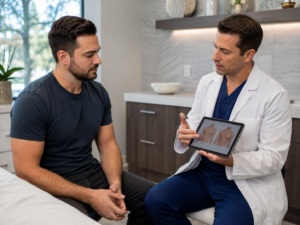
ASPS states that a gynecomastia consultation may include an evaluation of general health, medications and medical history, breast measurements, skin quality, and nipple and areola position. In some cases, diagnostic testing may be used to investigate an underlying cause.
Dr. Hakki uses this evaluation to determine whether male breast reduction is appropriate and which surgical technique best fits the patient’s anatomy.
How Is Gynecomastia Surgery Performed?
Gynecomastia surgery is usually performed as an outpatient procedure and can often be completed within a few hours. Depending on the case, anesthesia may be general or local.
The technique depends on what is creating the chest fullness.
Liposuction for excess chest fat
When excess fat is the main issue, liposuction may be sufficient. A thin cannula is introduced through small incisions to remove localized fat and improve the overall chest contour.
ASPS explains that liposuction is generally used when gynecomastia is primarily related to excess fatty tissue.
You can learn more about this related procedure on Luxxery’s liposuction page.
Excision for glandular tissue
Dense glandular tissue usually requires direct removal rather than liposuction alone. Depending on your anatomy, incisions may be placed around the areola, below the chest, or in the underarm area.
Luxxery notes that incision placement depends on the individual surgical plan and that Dr. Hakki takes care with incision positioning to help minimize the visibility of residual scars.
Combination treatment
Many patients have both glandular tissue and excess fat. In those cases, liposuction and excision may be combined to address different components of the chest enlargement. ASPS also recognizes combined liposuction and excision as a standard approach for selected gynecomastia cases.
The exact technique should be determined after an examination rather than based on photographs or online descriptions.

Where Are Gynecomastia Incisions Placed?
Incision placement depends on the amount and type of tissue that needs to be removed.
For glandular gynecomastia, incisions may be made near the edge of the areola, beneath the chest, or in the underarm region. If excess skin is significant, a larger skin-removal pattern may be necessary.
ASPS notes that excision is used when glandular tissue or excess skin needs to be removed, and that incision patterns vary according to the specific condition and surgical preference.
Luxxery states that Dr. Hakki pays particular attention to incision placement with the goal of making residual scarring as minimally noticeable as reasonably possible. However, any procedure that requires an incision can leave a permanent scar, even when the scar becomes less visible over time.
Your personal anatomy, amount of tissue, nipple position, and skin quality all influence where the incisions can be placed.
How Much Does Gynecomastia Surgery Cost in Maryland?
At Luxxery Boutique, the published average cost for male breast reduction for gynecomastia is $7,000 to $10,000. The practice states that this estimate includes the surgeon’s fee, anesthesia, use of the surgical facility, and follow-up care. The final price can vary because every surgical plan is customized.
For context, ASPS’s latest published cost page lists an average male breast reduction surgeon fee of $5,587, while noting that this figure does not include anesthesia, operating room or facility costs, and other related expenses. ASPS also reports a projected 2024 surgeon fee range of $5,000 to $9,000 for male breast reduction.
These figures should not be treated as identical quotes because they measure different components of the surgical cost.
| Cost Reference | Amount | What It Represents |
|---|---|---|
| Luxxery Boutique | $7,000 to $10,000 | Published surgical price including surgeon fee, anesthesia, facility, and follow-up care |
| ASPS latest average surgeon fee | $5,587 | Surgeon fee only, excluding anesthesia and facility costs |
| ASPS 2024 projected surgeon fee range | $5,000 to $9,000 | National surgeon fee range |
Luxxery states that its published surgical fees do not include pre-operative blood work or EKGs, special equipment when required, or revision surgery.
For current pricing and financing information, see Luxxery’s pricing and financing page.
What Is Included in the Gynecomastia Surgery Price?
A price comparison is only useful when you know what the quoted amount actually covers.
Luxxery states that the published surgical fee includes:
- Surgeon fee
- Anesthesia
- Use of the surgical facility
- Follow-up care
The practice notes that pre-operative testing, special equipment, and revision surgery are not included.
This distinction is important when comparing gynecomastia surgery costs in Maryland. A lower advertised surgeon fee may not represent the total amount you would pay once anesthesia, facility, garments, testing, and other expenses are added.
Your consultation is the appropriate time to ask for a written breakdown of your expected costs.
What Is Gynecomastia Surgery Recovery Like?
Most patients should expect some swelling, bruising, soreness, and temporary discomfort around the surgical area. Luxxery states that prescription medication may be used as needed and that a compression garment may be recommended for several weeks to protect the incisions and reduce swelling.
ASPS similarly notes that dressings, bandages, or a support garment may be used after surgery and that postoperative instructions will address incision care, medications, activity, and follow-up.
Typical recovery timeline
| Recovery Period | What You May Typically Expect |
| Days 1 to 3 | Rest, swelling, bruising, soreness, limited activity |
| First week | Gradually increasing mobility, compression garment if recommended, possible return to desk work |
| Weeks 2 to 3 | Many patients resume moderate daily activities |
| Weeks 4 to 6 | Gradual return to more demanding activity when cleared |
| After 6 weeks | Many patients can progressively resume strenuous exercise if healing is appropriate |
Luxxery reports that most patients can return to work within one week, resume moderate activities within two to three weeks, and avoid strenuous activity for at least four to six weeks.
This is a general framework, not a guarantee. Your surgeon may recommend a different timeline based on how much tissue was removed, whether liposuction was performed, incision healing, and your individual recovery.
When Can You Work Out After Gynecomastia Surgery?
One of the most common questions patients have is when they can return to the gym.
You may be walking and performing light daily activities relatively soon after surgery, but that does not mean you are ready for chest workouts, running, heavy lifting, or strenuous exercise.
Luxxery recommends avoiding strenuous activity for a minimum of four to six weeks.
The progression should generally be gradual. Your surgeon may clear normal walking before resistance training and light activity before more demanding chest exercises.
Exercises that place significant tension across healing incisions should not be restarted simply because you feel comfortable. Follow-up evaluation is important before returning to heavier workouts.
How Long Does Swelling Last After Male Breast Reduction?
Swelling usually improves progressively rather than disappearing within a few days.
During the early weeks, the chest may look uneven, feel firm, or appear more swollen than you expected. This does not necessarily reflect the final contour.
ASPS states that postoperative swelling gradually resolves and that final gynecomastia surgery results may take three to six months to become fully apparent. Incision lines are permanent but typically continue to fade over time.
Compression garments may be recommended during the early recovery period to support the chest and minimize swelling. The exact duration should come from your surgeon.
Dr. Hakki evaluates healing at follow-up appointments rather than using a fixed timeline for every patient.
Are Gynecomastia Surgery Results Permanent?
In many cases, the tissue removed during gynecomastia surgery does not grow back, but the long-term appearance of the chest can still be affected by future changes.
ASPS notes that results can be long-lasting, but gynecomastia related to certain medications, steroids, or weight gain may return or change unless the underlying factor is addressed and weight remains stable. ASPS specifically advises patients to discuss prescription medications with their physician rather than making changes independently.
This is why your consultation should address potential causes of gynecomastia as well as the surgical correction itself.
If anabolic steroids, recreational drugs, medications, or another medical issue may be contributing, tell your surgeon openly. That information can affect both the evaluation and surgical planning.
What Should You Expect During a Gynecomastia Consultation?
A consultation is more than simply asking, “How much does gynecomastia surgery cost?”
The purpose is to determine why your chest is enlarged, what tissue needs to be removed, where the incisions should be placed, and whether surgery is appropriate for you.
ASPS recommends discussing your goals, medical conditions, allergies, current medications, vitamins and supplements, alcohol and tobacco use, recreational drugs including steroids, and previous surgeries. The surgeon may also investigate an underlying cause when appropriate.
At Luxxery, Dr. Ayman R. Hakki is the surgeon who evaluates the patient’s anatomy and creates the treatment plan. He is certified by the American Board of Plastic Surgery, is a Fellow of the American College of Surgeons, and is a member of the American Society of Plastic Surgeons. He has practiced plastic surgery for more than three decades.
You can learn more about his training and professional background on the Dr. Ayman R. Hakki, MD page.
Is Gynecomastia Surgery Performed in an Accredited Surgical Center?
Gynecomastia surgery is typically an outpatient procedure, but the setting where surgery is performed is an important consideration.
ASPS advises patients to discuss where their operation will take place and emphasizes choosing appropriately accredited facilities for plastic surgery.
Luxxery Boutique has an accredited surgery center onsite in Maryland. The practice states that its onsite facility allows a wide variety of advanced procedures to be performed at the main office.
Luxxery also offers a private overnight surgical suite as an additional service for patients who may benefit from overnight postoperative support. The published service includes a private suite and 24-hour caregiver support, along with additional recovery amenities.
The overnight option is an additional service rather than a requirement for every gynecomastia patient. Whether it is appropriate depends on the procedure and individual circumstances.
What Are the Risks of Gynecomastia Surgery?
Like any surgical procedure, gynecomastia surgery carries potential risks.
ASPS lists possible complications including bleeding or hematoma, infection, blood clots, breast asymmetry, contour irregularities, changes in nipple or breast sensation, seroma, poor wound healing, persistent pain, unfavorable scarring, anesthesia-related complications, fat necrosis, and the possibility of revision surgery.
These risks do not mean that a complication will occur. Your individual risk profile depends on your health, medications, smoking status, surgical technique, and other factors.
You should discuss these risks directly with Dr. Hakki before deciding whether surgery is appropriate for you.
During recovery, serious symptoms such as shortness of breath, chest pain, or an unusual heartbeat require immediate medical attention. ASPS specifically advises seeking medical attention for these symptoms.
Can Weight Loss Get Rid of Gynecomastia?
Weight loss can reduce the amount of fat in the chest, but it does not necessarily remove glandular breast tissue.
This distinction is particularly important for men who have already lost a significant amount of weight but still have persistent chest fullness. If the remaining fullness is primarily glandular tissue or loose skin, additional weight loss may not produce the desired change.
For patients whose chest enlargement is primarily caused by excess fat, liposuction may be appropriate. When glandular tissue is present, excision may be required, and some patients need both approaches.
A physical examination is the most reliable way to determine what is contributing to your chest appearance.
Can You See Gynecomastia Surgery Results Immediately?
Some change in the chest contour can be visible soon after surgery, but the early appearance is affected by swelling and healing.
ASPS states that gynecomastia surgery results are visible relatively soon after the procedure, while swelling gradually resolves and the final result may take three to six months to develop.
This is one reason you should not judge the final outcome during the first few weeks.
Luxxery’s gynecomastia patient gallery includes patient photographs published with permission. The gallery should be used for general educational context only because individual results vary and photographs cannot predict the result of your own procedure.
How Can You Prepare for Gynecomastia Surgery?
The preparation period is an important part of the procedure, not just an administrative step.
Before surgery, your medical team may ask you to complete a health evaluation, discuss current medications and supplements, and make certain changes that reduce surgical risk. ASPS recommends discussing tobacco use, alcohol, medications, supplements, and steroid or recreational drug use during the consultation.
You should also plan practical matters before the day of surgery.
Your gynecomastia surgery preparation checklist
- Arrange transportation to and from surgery.
- Have someone available to help you during the initial recovery period as instructed.
- Prepare loose, comfortable clothing.
- Follow all medication instructions from your medical team.
- Avoid changing prescription medications without medical guidance.
- Arrange time away from physically demanding work.
- Plan to avoid strenuous exercise for several weeks.
- Keep follow-up appointments.
- Ask when you can shower, drive, work, and exercise.
- Confirm what is included in your surgical fee.
Having these details organized before surgery can make your first week much easier to manage.
How Should You Compare Gynecomastia Surgery Prices in Maryland?
The cheapest number is not necessarily the most useful number.
When comparing male breast reduction costs in Maryland, ask whether the quoted amount includes the surgeon, anesthesia, surgical facility, postoperative visits, compression garments, and any additional testing.
At Luxxery, the published $7,000 to $10,000 surgical fee includes the surgeon’s fee, anesthesia, surgical facility, and follow-up care. The practice’s published pricing page separately identifies pre-operative testing, special equipment, and revision surgery as exclusions.
Also evaluate the surgeon’s credentials and the surgical setting. Dr. Hakki is certified by the American Board of Plastic Surgery, a Fellow of the American College of Surgeons, and a member of the American Society of Plastic Surgeons. Luxxery’s surgery center is accredited and located onsite.
These factors do not guarantee a particular result or eliminate surgical risk, but they are relevant questions to consider when selecting a provider.

Frequently Asked Questions About Gynecomastia Surgery
How much does gynecomastia surgery cost in Maryland?
At Luxxery Boutique, male breast reduction for gynecomastia is currently listed at $7,000 to $10,000. The published fee includes the surgeon’s fee, anesthesia, surgical facility, and follow-up care. The final cost can vary according to the customized treatment plan.
How long does it take to recover from gynecomastia surgery?
Luxxery states that many patients return to work within about one week, resume moderate activities within two to three weeks, and avoid strenuous activities for at least four to six weeks. Individual recovery varies.
Will gynecomastia surgery leave scars?
Yes. Any surgical procedure requiring incisions can leave scars. Incisions may be placed around the areola, under the chest, or in the underarm area depending on the surgical technique. Scars can fade over time but should be considered permanent.
Can gynecomastia be treated with liposuction alone?
Sometimes. If chest enlargement is primarily caused by excess fat, liposuction may be sufficient. If glandular tissue is present, surgical excision may be needed, and some patients require a combination of liposuction and excision.
When can I return to the gym after gynecomastia surgery?
Luxxery recommends avoiding strenuous activity for at least four to six weeks. The exact timing for chest workouts, weightlifting, running, and other strenuous activities should be determined by your surgeon based on how you are healing.
Are gynecomastia surgery results permanent?
The tissue removed during surgery generally does not simply grow back, but future weight gain, certain medications, anabolic steroids, or other underlying causes can affect the chest again. ASPS recommends discussing medication-related causes with your physician rather than making changes on your own.
Does health insurance cover gynecomastia surgery?
Coverage varies by insurer and medical circumstances, but Luxxery states that its cosmetic and aesthetic procedures are elective and that health insurance does not cover those services. The practice offers financing options for qualified applicants through providers including Cherry, CareCredit®, and Alphaeon.
How do I know whether male breast reduction is right for me?
A consultation is the only reliable way to determine whether surgery is appropriate for your anatomy and goals. Dr. Hakki can assess whether your chest fullness is caused by glandular tissue, fat, loose skin, or a combination and explain the appropriate treatment options. Individual results vary, and a personal consultation is required for an accurate assessment.
Schedule a Gynecomastia Surgery Consultation in Maryland
If persistent chest fullness is affecting how you feel about your appearance, a consultation can help you understand what is actually causing it and whether male breast reduction is appropriate.
At Luxxery Boutique in Maryland, Dr. Ayman R. Hakki, MD is certified by the American Board of Plastic Surgery, is a Fellow of the American College of Surgeons, and is a member of the American Society of Plastic Surgeons. The practice’s accredited surgery center is onsite in Waldorf, Maryland, serving patients from Charles County, Southern Maryland, and the Washington, DC metro area.
You can review the gynecomastia surgery page, explore the patient gallery, or review pricing and financing options before your visit.
Schedule a free consultation with Dr. Hakki at Luxxery Boutique, 3010 Crain Highway, Suite 400, Waldorf, MD 20601, to discuss your candidacy, surgical technique, expected recovery, and personalized cost.
Individual results vary, and a personal consultation is required for an accurate assessment.