How to Choose a Plastic Surgeon: Credentials, Facilities and Questions
Working out how to choose a plastic surgeon is harder than it should be, because the title itself is not as protective as most people assume. In the United States, a licensed physician may legally perform cosmetic procedures without having completed a surgical residency in plastic surgery, and marketing language rarely makes the distinction clear.
That is not an argument for anxiety. It is an argument for checking a small number of specific things, all of which are publicly verifiable in a few minutes. This article sets out what those are, what they mean, and what to ask once you are sitting in a consultation.
Nothing here is medical advice, and no article can tell you whether a particular procedure is appropriate for you. That is a conversation with a qualified surgeon who has examined you.
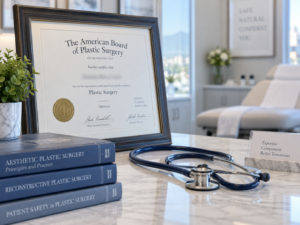
Start with board certification, and check it yourself
Board certification means a physician has completed accredited training in a defined specialty and passed that specialty’s examinations.
For plastic surgery, the relevant credential is certification by the American Board of Plastic Surgery, which is the member board of the American Board of Medical Specialties covering plastic surgery of the entire body. Certification requires completion of an accredited residency and passing written and oral examinations.
The reason this matters is that several similar-sounding boards exist, and not all of them are recognised by the American Board of Medical Specialties. A physician can accurately describe themselves as “board certified” while holding certification from a board with different requirements, or in a different specialty entirely.
How to check. Both the ABMS Certification Matters directory and the American Board of Plastic Surgery’s own verification tool let you look up a physician by name and see what they are certified in and whether that certification is current. It takes a couple of minutes and it is the single most useful thing you can do.
What to look for beyond the word “certified”: which board, in which specialty, and whether it is active.
Check where the procedure will actually take place
The surgeon is one half of the question. The facility is the other, and it gets far less attention.
Surgery may be performed in a hospital, in a licensed ambulatory surgery centre, or in an office-based surgical facility. All three can be entirely appropriate. What matters is accreditation and what that accreditation requires.
Accrediting bodies for office and ambulatory surgical facilities include the Accreditation Association for Ambulatory Health Care, the Joint Commission, and the American Association for Accreditation of Ambulatory Surgery Facilities. Accreditation covers equipment, sterilisation, staffing, emergency protocols and anaesthesia standards.
Questions worth asking: Where will the procedure be done? Is the facility accredited, and by whom? Who administers anaesthesia, and what are their credentials? What happens if there is a complication during the procedure, and what is the transfer arrangement with a nearby hospital?
Hospital privileges are a useful signal even for an office procedure. A surgeon with admitting privileges at a local hospital for the procedure in question has been through that hospital’s credentialing process, which is an independent review of their training and standing.

Look at the specific procedure, not just the surgeon
Plastic surgery is a wide field, and surgeons develop different areas of focus within it. A surgeon with extensive experience in one area may do a given procedure occasionally.
Reasonable questions: How often do you perform this particular procedure? How long have you been doing it? What proportion of your practice is this?
There is no magic number that makes an answer good, and the point is not to catch anybody out. It is to understand whether this is routine work for them or something at the edge of their practice.
Before-and-after photographs are worth looking at with a specific lens. Look for patients whose starting point resembles yours rather than for the most dramatic results. Look at the photography itself: consistent lighting, angle and distance between the before and after images, since inconsistent photography can flatter a result considerably. Ask whether the photographs are of the surgeon’s own patients.
Read reviews properly
Online reviews are useful and they need reading with some care.
Patterns matter more than individual reviews. A single unhappy review among many positive ones tells you little. A recurring theme, whether positive or negative, tells you more.
Look at what the reviews are about. Reviews praising the front desk and the waiting room are pleasant and not very informative. Reviews describing the consultation, how questions were handled, the follow-up and how a complication was managed are the ones worth reading.
Be cautious about both extremes. A practice with nothing but five-star reviews and a practice with a cluster of very angry ones both warrant a closer look.
Check more than one source, since different platforms attract different reviewers.
You can read patient reviews of our practice alongside whatever you find elsewhere.

What a good consultation looks like
The consultation is the best information you will get, and it works in both directions: you are assessing them while they assess you.
Signs of a consultation going well:
- The surgeon examines you before discussing options, rather than the other way around.
- You are told what a procedure cannot do as clearly as what it can.
- Alternatives are raised, including doing nothing or waiting.
- Risks and recovery are described in specific rather than general terms.
- Your questions are answered directly, and you are not made to feel you are asking too many.
- Cost is explained in full, including anaesthesia, facility fees and follow-up, rather than as a single headline figure.
- You are given time to think about it.
Signs worth taking seriously in the other direction:
- Pressure to decide during the visit, or a discount that expires if you leave.
- A recommendation before an examination.
- Reluctance to discuss risks, or risks described as negligible.
- You meet a consultant or a coordinator but not the surgeon who would operate.
- Vagueness about who performs the procedure, where, and who provides the anaesthesia.
- Guarantees about outcomes. Surgery does not come with guarantees, and a surgeon offering one is telling you something about how they communicate.
Questions to take with you
Written down, because consultations move quickly.
About the surgeon
- Which board are you certified by, and in what specialty?
- How often do you perform this procedure?
- Do you have hospital privileges for it, and where?
About the procedure
- Am I a reasonable candidate, and why or why not?
- What are the realistic limitations in my case?
- What are the alternatives, including less invasive options and doing nothing?
- What are the most common complications, and how often do they occur in your practice?
- What would revision involve if the result were not what we planned?
About the facility and the team
- Where will this be performed, and is that facility accredited?
- Who administers anaesthesia, and what are their qualifications?
- What is the emergency plan and the hospital transfer arrangement?
About recovery
- How long before I can return to work, to driving, to exercise?
- What does follow-up look like, and is it included?
- Who do I contact out of hours if I am concerned?
About cost
- What is the total, including surgeon’s fee, facility fee, anaesthesia and follow-up?
- What is not included?
- What would a revision cost?
On that last set, our pricing and financing page sets out how we handle the financial side, and a specific figure follows an examination rather than preceding it, because the plan determines the cost.
Timing and how long to take
There is no reason to rush this, and several reasons not to.
Consult more than one surgeon if you are uncertain. Most people would get a second opinion on a significant home renovation, and this is a larger decision. A surgeon confident in their recommendation will not object.
Allow time between the consultation and the decision. A plan that still makes sense a fortnight later is a better foundation than one agreed in the room.
Think about the calendar. Recovery takes the time it takes, follow-up appointments have their own schedule, and planning around a fixed event works better when the date is raised at the start. If there is a wedding, a holiday or a period at work when being away is impossible, say so early.
Be honest about your health history. Medications, supplements, smoking and previous surgery all affect what is advisable and how recovery goes. A surgeon can only plan around what they know.
How to prepare for the consultation
A consultation is more useful when you arrive with a few things ready.
A clear description of what bothers you, rather than a procedure name. “I do not like how this looks in fitted clothes” gives a surgeon more to work with than naming an operation you read about, because the examination may point toward something different from what you had in mind.
Photographs, if they help you explain. Images of results you find appealing are useful as communication, with the caveat that another person’s anatomy and starting point are not yours, and a photograph is a record of someone else’s outcome rather than a specification for yours.
A full list of medications and supplements, including over-the-counter products and anything herbal. Several common supplements affect bleeding and are relevant to surgical planning, and people routinely forget to mention them because they do not think of them as medication.
Your medical history, including previous surgery, anaesthesia experience, ongoing conditions and whether you smoke. This is the information that most affects what is advisable, and it is not a test you can fail.
Your questions, written down. Consultations move quickly and the question you meant to ask is the one you remember in the car.
Someone with you, if you would find that helpful. A second person hears things you miss and remembers them afterwards. This is common and nobody will find it unusual.
Reading advertising and social media carefully
Much of what people see about cosmetic surgery now arrives through advertising and social media rather than through a referral, and it is worth reading with some scepticism.
Results shown online are selected. Nobody posts their average outcome. This is not dishonest in itself, and it does mean a feed is a highlights reel rather than a representative sample.
Editing is invisible. Lighting, posture, angle and retouching all change an image substantially, and before-and-after pairs that differ in any of those are not comparable.
“Board certified” without a named board tells you very little, as covered above. The same applies to impressive-sounding fellowships and memberships, some of which have rigorous requirements and some of which require a fee.
Time-limited pricing is a sales technique, and a decision about surgery should not be paced by a promotion.
A large following is a measure of marketing, not of surgical skill. They are not mutually exclusive and they are not the same thing, and one does not evidence the other.
The verification steps earlier in this article cut through most of this in a few minutes, which is why they are worth doing before the marketing has had a chance to do its work.
A note on comparing prices
Cost is a legitimate factor and it is a poor primary criterion.
Prices vary for reasons that are not always visible in a quote: the facility, the anaesthesia provider, the surgeon’s experience, the time allocated, and what follow-up is included. A quote that is substantially lower than others is worth understanding rather than simply accepting, and the useful question is what is different rather than what is cheaper.
Medical tourism raises the same question with an additional one attached, which is what happens if something needs attention after you have flown home. Aftercare is part of the procedure, not an optional extra, and distance complicates it.
Frequently asked questions
How do I verify a surgeon’s board certification?
Look them up directly rather than relying on a website claim. The ABMS Certification Matters directory and the American Board of Plastic Surgery’s verification tool both allow a search by name and show the specialty and whether certification is current. This is free and takes a few minutes.
Is any licensed doctor allowed to perform cosmetic surgery?
In the United States, medical licensure is generally not limited by specialty, so a licensed physician may perform procedures outside the field they trained in. That is precisely why verifying the specific board and specialty matters, rather than relying on the phrase “board certified” on its own.
Does the facility matter if the procedure is done in an office?
Yes. Office-based surgical facilities can be entirely appropriate, and accreditation is what tells you the equipment, sterilisation, staffing, anaesthesia standards and emergency protocols have been independently reviewed. Ask which body accredits the facility and what the hospital transfer arrangement is.
How many consultations should I have before deciding?
At least one, and more if you are uncertain or if recommendations differ. There is no cost to taking a second opinion beyond your time, and a surgeon who is confident in their assessment will not be troubled by it.
What should make me hesitate about a practice?
Pressure to decide on the day, a discount that expires, a recommendation made before an examination, reluctance to discuss risks, not meeting the surgeon who would operate, and any guarantee about the outcome. None of these is definitive on its own, and each is worth noticing.
Should I choose based on price?
Cost is a real consideration and a poor primary one. Quotes differ because of the facility, the anaesthesia provider, the time allocated and what follow-up is included. When a quote is much lower than others, the useful question is what is different about it rather than assuming it is simply better value.
Taking the next step
The short version: verify the board and the specialty yourself, ask where the procedure happens and whether that facility is accredited, ask how often this particular surgeon does this particular procedure, and pay attention to how the consultation is conducted. Those four checks filter out most of what people worry about, and they take very little time.
Then take as long as you need. A decision that still makes sense a few weeks later is a better decision.
You can read about Dr. Ayman R. Hakki and verify his credentials independently through the directories above, learn more about our practice, and see the procedures we offer including liposuction, mini tummy tuck, breast lift, breast augmentation and mommy makeover.
Consultations at Luxxery are complimentary and carry no obligation. If you decide not to proceed, you leave with information, which is a perfectly good outcome for a consultation.